How TCM and Western Medicine View the Seasons Differently
The Hidden Seasonal Calendar That Can Transform Your Health
You may have never noticed — but they’ve been quietly affecting your body all along
Most of us learned the four seasons based on the Western (Gregorian) calendar:
Spring: March 20 – June 20
Summer: June 21 – September 22
Autumn: September 23 – December 20
Winter: December 21 – March 19
This approach is based on astronomy — particularly the equinoxes and solstices — and reflects changes in daylight and solar position.It makes sense for weather observation and agriculture, but from a Traditional Chinese Medicine (TCM) perspective, this calendar doesn’t fully align with the rhythms of the human body.
If You’re Following the “Western Seasons” to Stay Healthy — You Might Already Be a Step Behind
Have you ever noticed that:
By the time the spring equinox arrives in late March, you still feel stuck in “winter mode”?
Summer heat makes you restless or sleepless even though “summer” just officially began?
You start coughing or feeling dry before the fall season even hits the calendar?
You begin nourishing your kidneys after winter solstice, but you’re already feeling cold, tired, and depleted?
These are signs that your body is not responding to the calendar, but rather to subtle energetic changes in nature.
And over 2,000 years ago, TCM practitioners had already created a much more refined timekeeping system to track those changes — the 24 Solar Terms.
How TCM Views the Seasons: It’s All About the Flow of “Qi”
In Traditional Chinese Medicine, seasons are not defined by temperature or weather, but by the shifting movements of Qi (vital energy) in the environment.
The flow of Qi in nature — whether it’s rising in spring, flourishing in summer, contracting in autumn, or storing in winter — mirrors the energetic flow in your body. That’s why TCM doesn’t rely on Western season dates. It uses the 24 Solar Terms (Jieqi, 节气) — a system of 24 solar divisions, each marking a specific phase in the Earth’s orbit around the sun.
🗓 The 24 Solar Terms — Your Body’s Natural Calendar
Each solar term lasts about 15 days. Together, they form a powerful seasonal rhythm that guides not just farming, but also lifestyle, diet, and emotional health.
Here’s a simplified version of the 24 terms, along with their timing and significance:
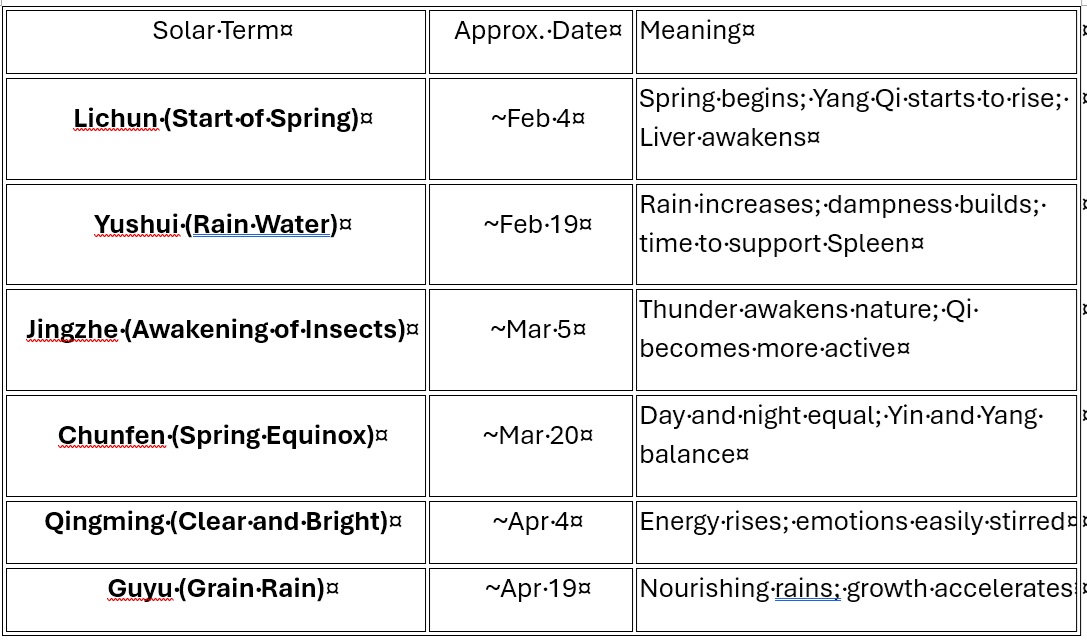
| Lixia (Start of Summer) | ~May 5 | Summer begins; Heart Yang rises| Xiaoman (Grain Full) | ~May 20 | Crops begin to ripen; damp-heat may emerge| Mangzhong (Grain in Ear) | ~Jun 5 | Peak growth; time to release excess heat| Xiazhi (Summer Solstice) | ~Jun 21 | Longest day; Yang Qi reaches its peak| Xiaoshu (Minor Heat) | ~Jul 6 | Hot and humid weather increases| Dashu (Major Heat) | ~Jul 22 | Hottest time of year; Heart Fire is strongest
| Liqiu (Start of Autumn) | ~Aug 7 | Autumn begins; Qi begins to contract| Chushu (End of Heat) | ~Aug 23 | Heat dissipates; dryness may start| Bailu (White Dew) | ~Sep 7 | Morning dew appears; dryness increases| Qiufen (Autumn Equinox) | ~Sep 22 | Day and night equal again; dryness intensifies| Hanlu (Cold Dew) | ~Oct 8 | Coldness deepens; protect your lungs| Shuangjiang (Frost’s Descent) | ~Oct 23 | Frost begins; time to preserve warmth
| Lidong (Start of Winter) | ~Nov 7 | Winter begins; Yang Qi stores inward| Xiaoxue (Minor Snow) | ~Nov 22 | Cold sets in; start winter nourishment| Daxue (Major Snow) | ~Dec 7 | Cold intensifies; rest is essential| Dongzhi (Winter Solstice) | ~Dec 21 | Shortest day; Yang begins to return| Xiaohan (Minor Cold) | ~Jan 5 | Cold becomes stronger; protect Kidney Yang| Dahan (Major Cold) | ~Jan 20 | Coldest part of the year; prepare for spring
The Four TCM Seasons — Starting Earlier Than You Think
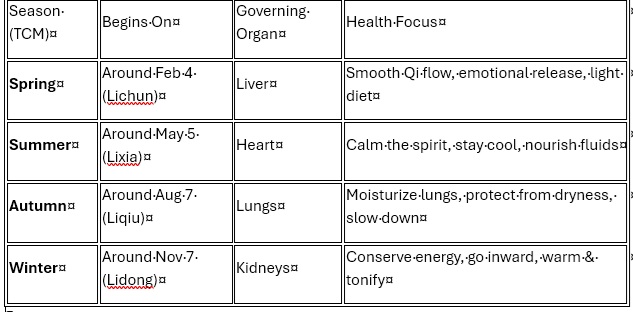
In TCM, each season begins with a “Li” term — Lichun (Spring), Lixia (Summer), Liqiu (Autumn), Lidong (Winter). These are earlier than the Western seasonal markers.
Why “Following the Solar Terms” Is Better for Your Body
Let’s take a few real-life examples:
You start spring detox in March — but Liver Qi began moving back in early February
You begin protecting your heart in late June — but Heart Fire was already rising in early May
You wait until October to moisten the lungs — yet Lung Qi has been affected by dryness since August
You start warming your kidneys in late December — but Winter storage began in early November
See the pattern? If you wait for the weather to catch up, you’re likely a month or more too late.
The Power of Living with the Seasons
Seasonal living in TCM is not about doing more — it’s about doing things at the right time.
When you follow the flow of Qi in nature:
You feel more balanced during seasonal transitions
You’re less likely to get colds, insomnia, fatigue, or emotional imbalances
Your digestion, immunity, and energy gradually improve
You prevent illness before it begins
In other words: true healing happens quietly, and ahead of time.
People often say, “I’ve tried to live healthier, but I don’t feel much change.”
Here’s the truth:It’s not just about what you do — but when you do it.
The wisdom of TCM reminds us that health is not reactive — it’s rhythmic.Your body follows nature, not your calendar app.
🌱 The four seasons are not just scenery.They are your body’s internal clock.✨ When you learn to live by the solar terms, you’re not just following tradition —You’re reclaiming harmony with yourself.