How the Four Seasons Work Differently in Chinese Medicine vs. the Western Calendar And Why It Matters for Your Health
Understanding the Seasons in Traditional Chinese Medicine: A Different Calendar for a Healthier You
Most of us were raised to understand the seasons according to the Western (Gregorian) calendar:
Spring: March 20 – June 20
Summer: June 21 – September 22
Fall: September 23 – December 20
Winter: December 21 – March 19
These seasonal divisions are based on astronomical events, such as solstices and equinoxes. However, in Traditional Chinese Medicine (TCM), the concept of seasons is rooted in a different system—one that follows the rhythm of the sun with great precision and has guided health, agriculture, and lifestyle in Chinese culture for over 2,000 years.
In TCM, the Seasons Follow the Sun—Literally
TCM is based on the 24 Solar Terms (节气)—a sophisticated system that divides the year according to the sun’s position along the ecliptic. This solar calendar marks seasonal changes more accurately in terms of natural energetic shifts, and it plays a central role in how TCM practitioners guide health and disease prevention.
In this system:
Spring begins around February 4 (Start of Spring – 立春)
Summer begins around May 5 (Start of Summer – 立夏)
Autumn begins around August 7 (Start of Autumn – 立秋)
Winter begins around November 7 (Start of Winter – 立冬)
Each season still spans approximately three months, but starts earlier than what the Western calendar suggests. This shift matters deeply—because in TCM, each season governs specific internal organs, emotions, and elemental energies in the body.
Why This Matters for Your Health
The foundation of TCM is to live in harmony with nature. When we align our internal rhythms with the external seasonal changes, we support the flow of Qi (vital energy) and promote overall balance and resilience.
Let’s compare the seasonal systems and their TCM health focus:
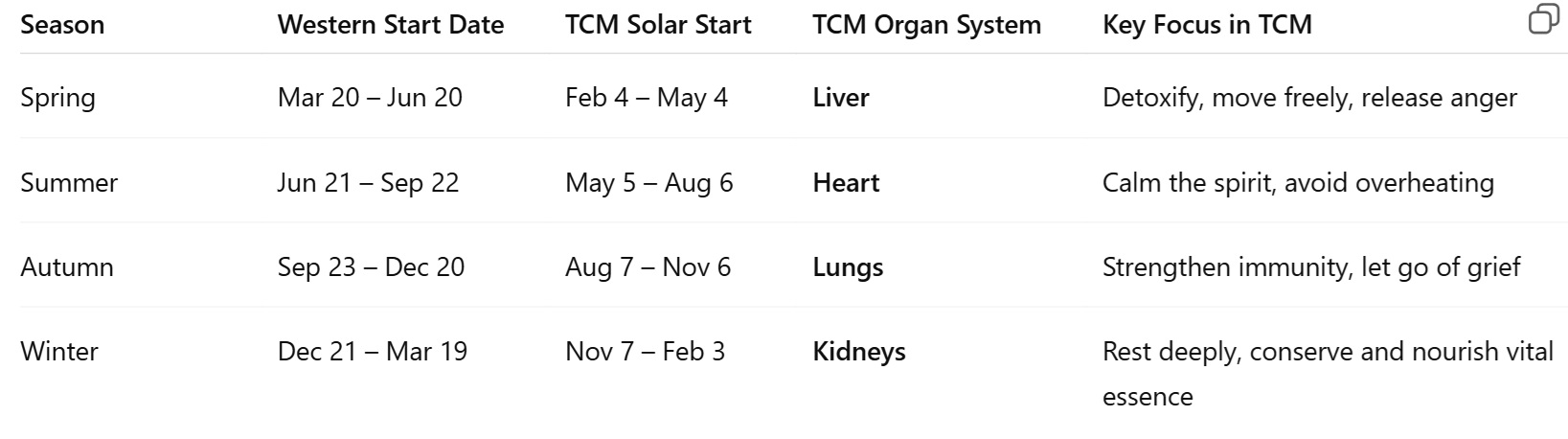
Real-Life Application: Spring Cleansing Begins in February
In the West, spring cleaning typically starts in March or April. But in Chinese medicine, the Liver system, which governs the spring season, already begins activating around early February.
If you wait until April to support your Liver with detoxification or movement, you may miss the optimal window for renewal. That’s why many TCM practitioners begin spring Liver cleansing, emotional release, and Qi-moving practices shortly after the Lunar New Year.
Living in Sync with Nature Is Living in Sync with Yourself
TCM is not just about treating illness—it’s about anticipating the body’s needs as the environment changes. By aligning your lifestyle with the energetic rhythms of the seasons, you can:
Minimize fatigue and sluggishness during seasonal transitions
Support stable digestion, mood, and sleep
Strengthen your immune system and body’s self-healing capacity
Practical Tip: Feel the Season’s Energy, Not Just the Weather
Even if it still feels like winter in February, TCM recognizes that spring energy is already rising. Your body responds to subtle shifts in solar energy before the temperature catches up.
To support your spring transition, begin to:
Wake up earlier
Increase physical movement
Eat lighter, green-colored, upward-growing foods
Gently release frustration or emotional stagnation
Final Thought
If you’ve ever felt “off” during seasonal changes—despite mild weather—it may be your body sensing deeper energetic transitions that the Western calendar doesn’t fully reflect.
Learning to live by the TCM seasonal calendar empowers you to care for your body in advance, prevent imbalance before it arises, and tap into a deeper rhythm of wellness.